What I’ve been reading – May 2023

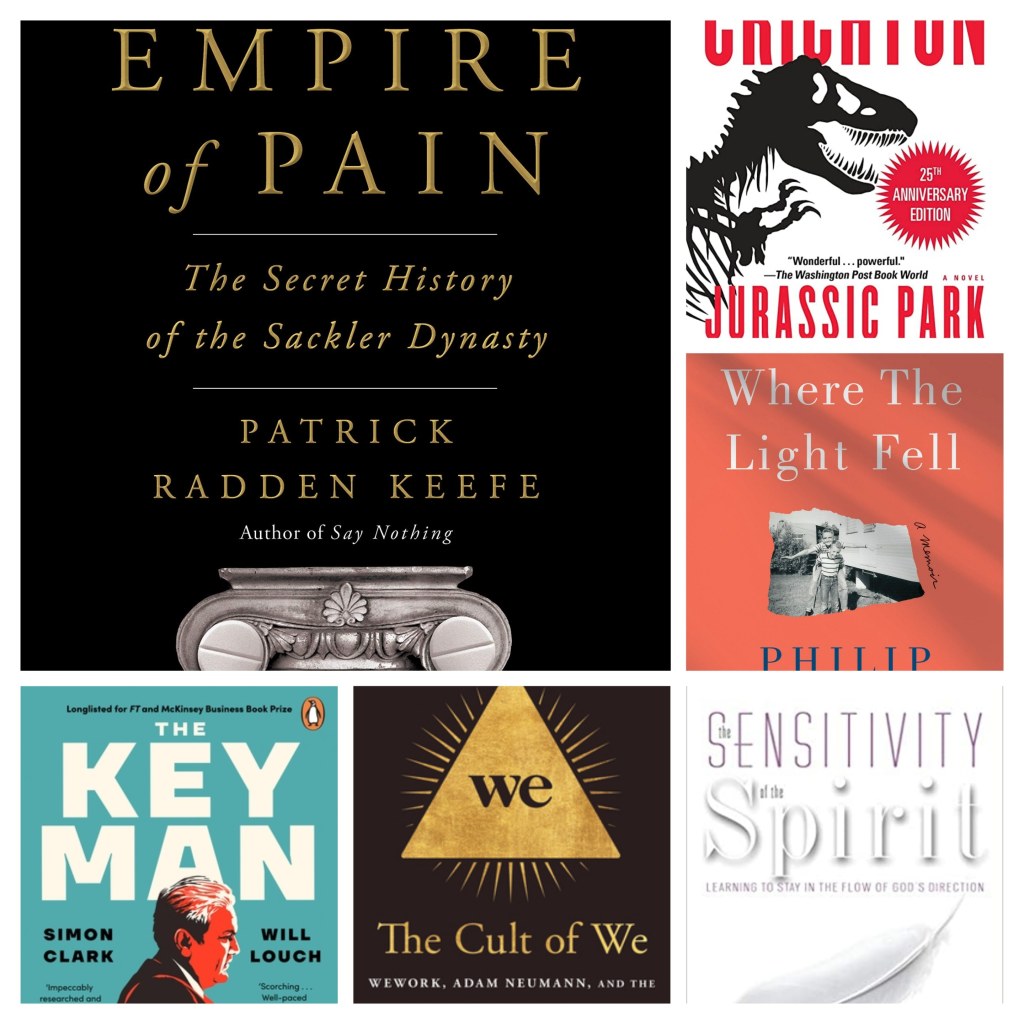
Snapshot of the covers I read

I’ve read some really flipping good books this year and now I’m going to subject you to my thoughts on what should make its way onto your reading list.

EMPIRE OF PAIN RADDEN KEEFE:Oh man. The Sacklers and their OxyContin drug were the beating (avarice-driven) heart of the opioid epidemic. But seeing the epidemic set in its generational context and how actions of the second generation Sacklers were rooted in the sins of the first was mind-blowing. Also a salutary tale on what happens when you outsource your morals to lawyers (ahem).

WHERE THE LIGHT FELL, YANCEY: I’ve always liked Yancey’s books. I met the man once and he was genuinely kind to me. His memoir was thought provoking, interesting and engaging. Like the man himself. Highly recommend.

JURASSIC PARK, CRICHTON: Somehow I’d never read this book. Stands the test of time as a fun little read.

THE KEY MAN, CLARK AND LOUCHE: I couldn’t put this narrative about the Abraaj rise/collapse down. Heartbreaking for those of us in impact investing, but the story is so utterly absurd and engrossing and maddening. Also funny to read a book where you know some of the players!

THE CULT OF WE, BROWN AND FARRELL: The rise and fall of WeWork and its founder is a rollercoaster of Silicon Valley and VC-fuelled madness. I particularly liked the description of WeWork space as “catnip for millennials”

SENSITIVITY OF THE SPIRIT, RT KENDALL: Very challenging. Stewarding the presence requires the gentleness of dealing with a dove.

(Cross-post from my Instagram)

Surprised by fatherhood: a list

1. The washing. My goodness, the washing. How does somebody so small generate so much laundry?!

2. Everything I own has a little bit of vomit on it now.

3. The love I immediately had for him was unconditional and irrational and visceral and fully complete.

4. It is surprisingly easy to switch from “playtime Dad voice” to “serious lawyer voice” in mere seconds.

5. You spend more time than you would think on your hands and knees every day looking for dummies and teethers and lost socks.

6. How he can wake up every hour from midnight to 5am but somehow when he smiles at me at 7am the room will brighten and all is forgotten.

7. It’s possible to attend relatively serious (Teams) meetings with vomit on one’s shirt but still project credibility.

8. I wouldn’t trade any of it for the world (though I would pay a handsome sum for a good night’s sleep).

2021: a bit much…

I’ve become fond of saying “2021 is a bit much”. And to be frank, it has been. Perhaps that’s an understatement.

That’s not to say it’s been a bad year, personally; it hasn’t.

It’s just been… a bit much.

At its height, its gift from God was our beautiful baby boy. At its nadir, its cruellest cut was saying goodbye to my grandfather by zoom. Then there was changing jobs and balancing career growth with a family, navigating the highs and lows parenthood, entering a third year without seeing my family, loved ones’ health issues, watching lockdowns come and go, making new friends and trying to be the best husband I can.

Clearly it wasn’t all bad. It was just… a bit much.

I’m tired.

I think many of us are.

Here’s to 2022 being the right amount of stuff and not another year of being… a bit much.

2020 reading highs and lows

“You know what we haven’t had a lot of lately? Rambling from James about what he has loved and hated reading this year!” Well then… Some selections from the ~30 I’ve got through so far.

The good, the bad and the meh

WHAT WAS GOOD?
THE PLACES IN BETWEEN (Stewart): Rory Stewart literally walked through Afghanistan in 2001. This was his endearing and engaging account of that. Must read. It’s nearly 20 years old but holds up very well (and with some closing salutary lessons about my own industry, international development). I wish I could write with the same pith that Stewart writes with.
CHURCH HISTORY (Shelley): a gracious walk through church history – though really a walk through the history of the Western church as it sadly neglects the post-schism eastern church, and believers in the far East pre-1800. I was left reflecting on the damage done to the church – in its witness and to its integrity – when the church compromises its principles in pursuit of influence or power (a lesson our evangelical American friends would do well to heed).
SABBATH (Else): Slee is a CoE academic and this really helped me at the start of the year when I was completely wrung out and needed to rediscover a rhythm of rest.
WILDING (Tree): a fascinating account of returning a dairy farm to nature, and the process and controversies that go with it. Opened my eyes to species reintroducions and other debates.
JERUSALEM: THE BIOGRAPHY (Montefiore): this was also excellent but I’ve already written about it!


AND WHAT WAS BAD?
12 RULES FOR LIFE (Peterson): psychobabble claptrap.
THE TIPPING POINT (Gladwell): How is this famous? Boring boring boring.

What I’m reading over Christmas to follow… Cheese, Arabia and babies.

Letter to a teacher

I’m currently reading a very wholesome book called Write a Letter by Jodi Ann Bickley.

One of the early exercises asks you to write a letter to a teacher who inspired you. Well, here it is.

========================

Dear Max

It feels strange to call you that, but I’m in my mid 30’s now and so I think it’s reasonable for me to do so!

It has been nearly 20 years since I finished up at [school name redacted]. Since then, I’ve lived in five different cities across the world and visited or worked in something like 25 different countries. I say this not to aggrandise myself, but to point out that God has been good to me in giving me the sort of experiences that the awkward ‘teenager me’ could only have dreamed about (but probably didn’t dream about, because teenagers are not clever enough).

I write clearly enough; I always have. But what I haven’t been doing well enough in is writing for pleasure, or to stay in touch. As a result, I have spent a good amount of 2020 writing for pleasure, writing to friends or just typing and seeing where the words take me. Some of my writing has been published in a few industry publications. Even then, finding inspiration is sometimes a bit difficult.

As a kind of remedy, I’m currently reading a book called ‘Write a Letter’. The very first exercise asks you to write to a teacher who inspired you. I feel as though you won’t be offended that I didn’t think of you first. I was at [school] 20 years ago and, frankly, barely remember it, let alone the teachers.

However, as I mulled over it this morning, you bubbled to mind. And as I thought about it more, I realised that it was because the enduring memory that sticks with me is that you had respect for me.

There are good teachers and there are bad teachers, I am sure… But ‘teachers’ aside, there are also educators and potential-seekers. I think you were one of those.

The respect you had for me – as an individual, as a human – is something that I can still vividly remember, and set you apart from others in the faculty (not just at [School], but generally).

A few distinct memories of you from my time at [School] came to mind today. Two are pertinent here:

  1. In probably the only ‘bad’ thing I ever did at school, I found myself in trouble for being a smart-arse to a teacher (whose name I recall but I won’t mention). I was dropped a ‘behaviour level’ (which, in hindsight, was a pretty ungracious system) and sent off to a few detentions. Incidentally, my sentence was kindly mitigated by my ally – the deputy principal – which proved to be an early lesson in the value of what is known in the Middle East as ‘wasta’. As I came to the end of my last detention, you publicly commended me in the detention room for accepting my sentence in good grace, accepting what I did was wrong and moving on with life. It probably made me look like a golden child, but you called out the good in a (very mildly) bad situation and the lesson stuck with me.
  2. On my very last day of school – education complete, bar for the ceremony – you took time to pull me aside and give me (and my Dad, if I recall), some guidance on possible career that you felt I might not have come across or given enough thought to. You were extremely gracious in doing so, and called out skills that you saw in me that (as a skinny 16 year old) I hadn’t yet seen. In fact, I didn’t really begin to use those skills until about 5 years into my career (ten years or so after you saw them).

So, all of that aside – thank you. You showed respect to a 16 year old who was a bit of a non-entity. I think that is why I thought of you when the book asked me to think about a teacher who inspired you. That kindness has stuck with me.

Yours

James

Social Impact Bonds – when are they the right choice?

I’m very fortunate that my work takes me into interesting and innovative territory, including working on transactions that mobilise capital for social aims. One such emerging mechanism (albeit one with a 10 year track record) is social impact bonds.

I have this piece out today in The Catalyst called “When is the Right Time to Use a Social Impact Bond?”, exploring when a Social Impact Bond is the right choice for your social transaction (and, by extension, when not!).

On rest

My year started with a book that came to me with providential timing.

Last year was a tough year. Really tough. I ended it thoroughly depleted; staggering into the Christmas break emotionally, spiritually and physically wrung out. More than ever, I needed a rest… a sabbath, if you will.

Enter: Sabbath, by Nicola Slee. Slee’s thoughtful and vulnerable book is based on a poem by Wendell Berry, which begins describing his journey into sabbath rest:

I go among trees and sit still.
All my stirring becomes quiet
around me like circles on water.

Wendell Berry, Sabbaths

Real rest requires an element of intentionality – a deliberate pause in order to find the stillness. As my exhausted brain worked through the mess of the year, it began to quiet as I allowed it to process, rejuvenate, recharge.

Reflecting on the book, and on my own relationship with rest, it occurred to me that sabbath actually has an element of work; it involves the work of resting.

To rest actively requires us to consider what has made us tired, and to sort through the chaff in our minds.

But fortunately, this quiet work of the sabbath comes with a reward.

After days of labor,
mute in my consternations,
I hear my song at last,
and I sing it. As we sing,
the day turns, the trees move.

Wendell Berry, Sabbaths

Doing the hard work of rest is valuable. It is also, at times, painful. As I took stock and reflected, I could see truths and realities in a way that I could not in the noise and busy-ness of life.

As I approached the end of my break, I wrote in my journal:

This year – more than ever – I have limped over the finish line, frailer and sicker than I have ever been.

Slee says that this is normal – sometimes to enter sabbath is to have it all crash down on you as your body catches up. But this year has been particularly torrid and I think this has had an effect. The last few days have been tough. I begin work again tomorrow and my body knows it. I don’t want to do it.

I need more time.

Even just little more time.

Leaving sabbath is difficult, and not just because we connect with ourselves and with God in it.

Leaving sabbath is hard because we return to a world we do not control, and which has marched on in our absence. Even if I was in control of my world (which I am not), returning is hard as it has grown out of my control in my absence.

While I have been in sabbath, I have been discovering (or rather remembering) some of my passions that bring me joy.

And that, I suppose, is good. Anxiety may be the price of leaving my sabbath woods, but a renewed sense of self and (hopefully) better tools to find rest again are what I take from it.

There are certain parallels between leaving sabbath and leaving the strangeness of this season, whenever that may be.

2020 has forced many of us into a form of sabbath; a mandatory degree of rest and reflection that we have not had before. In many senses, the year has been traumatic… But it has also been an opportunity to reset and renew our inner worlds.

Leaving this form of sabbath will come with its own challenges.

Leaving any sabbath is hard. But eventually the sabbath must end.

The key is to take its lessons and its energies to meet the new day.